Aerosphere vs CO2Meter: Monitoring & Sensing Equipment Comparison

When it comes to life safety and code compliance, choosing the best CO2 monitoring system for your facility is a crucial decision. Aerosphere and CO2Meter are two companies offering equipment designed to detect dangerous carbon dioxide levels. However, they differ in their areas of specialization, product offerings, and the services they provide to help businesses meet safety requirements.
Aerosphere specializes exclusively in CO2 safety monitoring and compliance for bulk CO2 storage systems, particularly those used in restaurants, convenience stores, breweries, and other beverage dispensing environments. Rather than splitting focus between a variety of gases and equipment, Aerosphere focuses on purpose-built CO2 safety systems, along with installation, permitting, inspections, and ongoing compliance services.
CO2Meter spreads their focus across handheld detectors, multi-gas monitors, indoor air quality devices, and fixed CO2 monitoring systems. While its catalog includes equipment for commercial bulk CO2 applications, this represents just one segment of a much more generalized product offering.
For businesses using bulk CO2, this difference in specialization is worth considering. Let's take a closer look at how the equipment compares.
Equipment Comparison: Aerosphere vs. CO2Meter
Both Aerosphere and CO2Meter offer fixed CO2 monitoring systems designed to detect elevated carbon dioxide levels and alert occupants to potentially dangerous conditions.
However, differences in alarm customization, sensor maintenance, accessories, and system connectivity can affect how well each system fits a particular facility's needs.
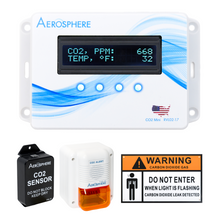
| Aerosphere Primary (RVL01-17) | CO2Meter (RAD-0102-6) | |
| Overall Compliance | ✅ Fully code-compliant | ⚠️ Depends on jurisdiction |
| MONITORING SYSTEM FEATURES | ||
| Sensor Accuracy | ± 50 ppm | ± 200 ppm |
| Detection Areas | Up to 4 sensing areas with additional Secondary monitors. | Supports 1 sensing area per individual unit. Can get expensive with larger setups. |
| Alarm Customizability | Adjustable thresholds from 0 to 50,000 ppm for all alarms. Adaptable to different local code requirements. | Limited threshold adjustments. First alarm fixed at 5,000 ppm TWA. May not meet certain local requirements. |
| Relays | Alarms can trigger relays at any combination of thresholds 1, 2, and/or 3. | Alarms trigger relays at thresholds 1, 2, and 3 respectively. |
| Common Alarm | Configurable common or individual alarms to accommodate different jurisdiction requirements. | Common alarm not possible. May not be compliant depending on jurisdiction. |
| Sensor Calibration | Factory-calibrated for up to 15 years. | Recalibration recommended every 2-3 years. |
| ADDITIONAL EQUIPMENT & CAPABILITIES | ||
| Outdoor Horn Strobes | IP65-rated Horn Strobes suitable for outdoor installation. | Not IP-rated. Not suitable for outdoor installation. |
| Safety Signage | Aluminum signage included in monitoring kits. | Adhesive sticker signage. |
| Multi-Facility Monitoring | Available through the Aerosphere Mark 2 and Portal. Remote CO2 and tank level readings across multiple locations. | No multi-location telemetry devices. |
Key Differences
1. Single-Zone vs. Multi-Zone Monitoring
One of the biggest differences between Aerosphere and CO2Meter is how their systems accommodate larger facilities.
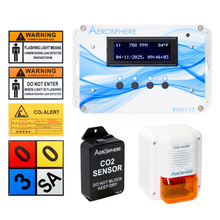
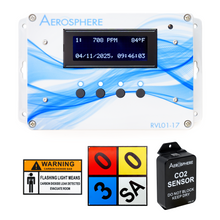
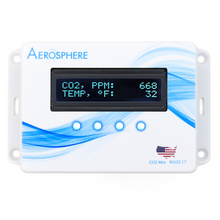
The Aerosphere Primary (RVL01-17) can monitor up to four independent areas by connecting additional Secondary monitors. This makes it easy to expand coverage across multiple rooms while keeping a central display.
The CO2Meter RAD-0102-6, on the other hand, monitors one area per unit. Facilities requiring coverage across multiple rooms will be needing additional independent systems, which can increase equipment costs.
General Recommendation:
- Larger facilities and multi-zone applications: Aerosphere Primary (RVL01-17). Ideal for breweries, grow houses, and facilities requiring CO2 detection across multiple areas.
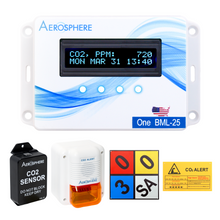
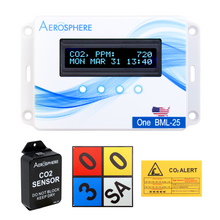
- Quick-service restaurants, convenience stores, and single-zone applications: Aerosphere ONE (BML-25). A budget-friendly alternative designed for locations requiring only one sensing area.
For single-zone monitoring, CO2Meter offers a standalone sensor option. While a separate central display is available, it is not included in the most basic package. Aerosphere systems always include a separate eye-level display, allowing staff to check CO2 levels before entering the monitored area. This visibility serves an important life-safety purpose: CO2 can accumulate near the floor, making it hazardous to enter the space or bend down to read a low-mounted sensor during a leak.
2. Alarm Customization & Code Compliance
Fire departments don't always enforce the IFC in exactly the same way. Having a system that can adapt to different local requirements is important to completely guarantee that your setup is compliant for your jurisdiction.
Aerosphere Primary (RVL01-17)
- All three alarm thresholds are adjustable from 0 to 50,000 ppm in 50 ppm increments.
- Default alarm settings are 5,000, 15,000, and 30,000 ppm.
- Optional 8-hour time-weighted average for the first alarm.
CO2Meter (RAD-0102-6)
- First alarm is set at 5,000 ppm using an 8-hour time-weighted average.
- Higher alarm thresholds offer more limited adjustment options.
Aerosphere offers greater flexibility to accommodate different fire code requirements.
3. Common Alarm Functionality
A common alarm allows a CO2 leak detected in one area to activate alarms throughout an entire facility.
The Aerosphere Primary can be configured for either common or individual alarms, allowing the system to adapt to different facility layouts and local fire department requirements.
The CO2Meter RAD-0102-6 operates as an independent monitoring system and does not provide the same common-alarm functionality across multiple sensing areas.
For facilities requiring a common alarm system, Aerosphere offers a straightforward solution without the need for separate monitoring systems.
4. Sensor Accuracy, Maintenance, and Durability
Beyond alarm functionality, sensor accuracy and long-term maintenance are important considerations when choosing a CO2 monitoring system.
Aerosphere Equipment
- Sensor Accuracy: ±50 ppm.
- Sensor Calibration: Factory-calibrated for up to 15 years.
- Horn Strobe: IP65-rated for outdoor installation.
CO2Meter (RAD-0102-6)
- Sensor Accuracy: ±200 ppm.
- Sensor Calibration: Calibration recommended every 2-3 years.
- Horn Strobe: No IP rating.
Aerosphere's sensors are designed for long-term operation without routine recalibration, potentially reducing maintenance requirements over the system's lifespan.
Additionally, Aerosphere's IP65-rated horn strobes provide protection against dust and water, making them suitable for outdoor installations. CO2Meter's standard horn strobes do not have a published IP rating, making them better suited for indoor applications unless otherwise approved.
CO2Meter's lower quality sensor technology may be acceptable for less demanding applications. For facilities prioritizing sensor accuracy, durability, and reduced maintenance, Aerosphere offers several advantages over the RAD-0102-6.
5. Multi-Facility Monitoring and Remote Access
For businesses operating multiple locations, having access to CO2 readings and tank levels remotely can make managing equipment significantly easier.
Aerosphere offers the Mark 2 (MK-2) monitoring system, which connects to the Aerosphere Portal to provide:
- Remote CO2 monitoring: View CO2 concentrations and identify potential leaks across multiple facilities.
- Tank level monitoring: Track bulk CO2 tank levels to help determine when refills are needed.
- Historical data and notifications: Access recorded readings and receive alerts without visiting each location.
This makes the Mark 2 particularly valuable for franchise operators, multi-location businesses, and facilities looking to centralize their CO2 monitoring.
CO2Meter does not offer a comparable multi-facility telemetry system.
Final Equipment Recommendation
For businesses prioritizing safety, reliability, and code compliance, Aerosphere is the recommended choice for commercial CO2 monitoring. With greater system customization, long-lasting sensors, and solutions for both single-location and multi-facility operations, Aerosphere offers the complete approach to bulk CO2 safety.
What About CO2 Compliance Services?
Choosing the right equipment is the foundation for CO2 safety and compliance. The support behind that equipment helps you navigate each step that follows. For a closer look at how Aerosphere and CO2Meter compare in permitting, installation, inspections, and ongoing compliance support, check out our Aerosphere vs. CO2Meter: Services Comparison.