What to Do at Different CO2 Alarm Levels — Alarm Response Guide

Carbon dioxide, or CO2, is a colorless, odorless gas that can become hazardous when it accumulates indoors. In businesses that use compressed or bulk CO2, such as restaurants, breweries, convenience stores, grow facilities, beverage stations, and other commercial spaces, a CO2 monitor helps provide early warning before conditions become dangerous.
The right response depends on the CO2 level, the layout of the facility, local fire code requirements, and your company’s internal safety procedures. The guidance below is a general overview. Always follow your local authority having jurisdiction, your business’s written emergency procedures, and the instructions provided by your CO2 safety equipment manufacturer.
Normal CO2 Levels: 400 - 1,000 ppm
Typical outdoor CO2 levels are usually around 400 ppm, while indoor occupied spaces are often higher depending on ventilation and occupancy. Readings between 400 and 1,000 ppm are generally considered normal for many occupied indoor spaces.
At this level, no emergency action is typically needed. Staff should continue normal operations and periodically confirm that the CO2 monitoring system is powered, visible, and functioning properly.
Low Alarm: 5,000 ppm
A 5,000 ppm alarm should be treated as an important warning. This level does not mean that everyone is in immediate life-threatening danger, but it should not be ignored.
OSHA’s permissible exposure limit for carbon dioxide is 5,000 ppm as an 8-hour time-weighted average. NIOSH also lists 5,000 ppm as its recommended exposure limit for an 8-hour workday. In practical terms, a brief alarm at 5,000 ppm is usually a warning that CO2 levels are elevated and that action should be taken before the situation worsens.
Recommended response:
Ventilate the affected area by opening doors or otherwise increasing airflow if it is safe to do so. Check the CO2 monitor to identify which sensor or zone is in alarm. This is one of the major benefits of a properly installed CO2 monitoring system because it can help staff identify where CO2 may be accumulating.
In beverage service areas, staff should also check all Bag in Box, or BIB, containers for empties and replace empty BIBs with new ones. Empty BIBs can cause beverage systems to continue dispensing or cycling in a way that may contribute to unnecessary CO2 release.
If the CO2 detector does not reset within 5 minutes and continues to alarm, staff should take Moderate Alarm Level action according to the facility’s protocol.
Moderate Alarm: 15,000 ppm
A 15,000 ppm alarm means CO2 has exceeded the second safety threshold.
This level should be taken seriously. It is well above OSHA’s 8-hour permissible exposure limit and may indicate an active CO2 leak, poor ventilation, or CO2 accumulation in a confined or low-lying area.
Recommended response:
Prop doors open to ventilate the affected area if it can be done safely. Follow your company protocol to have the system inspected and the CO2 equipment maintenanced.
A service technician should enter the affected room only according to company procedure. Many facility protocols require a technician to enter only with another technician present and with the door propped open for ventilation. Staff who are not trained or authorized should not enter the affected area to troubleshoot the system.
If the alarm escalates, the source cannot be identified safely, or anyone experiences symptoms such as dizziness, headache, confusion, shortness of breath, or unusual fatigue, evacuate the area and follow High Alarm procedures.
High Alarm: 30,000 ppm
A 30,000 ppm alarm is a high alarm and should be treated as a serious hazard.
NIOSH lists 30,000 ppm as the short-term exposure limit for carbon dioxide. CO2 exposure at this level or higher is considered extremely dangerous. For a facility alarm response, 30,000 ppm should not be treated as a troubleshooting level. It should be treated as an evacuation level.
Recommended response:
Call 911 to report the alarm. Do not enter the risk area.
Evacuate the store or affected facility area immediately. If doors can be propped open safely while exiting, do so to help ventilate the area until Emergency Services arrives. Evacuations should be reported to the District Manager, Safety Coordinator, or other designated internal contacts according to company procedure.
No one should re-enter the facility or affected area until it has been cleared by Emergency Services. After the incident, create a maintenance work order so the system, CO2 source, and affected equipment can be inspected and repaired as needed.
40,000 ppm: Immediately Dangerous to Life or Health
NIOSH identifies 40,000 ppm carbon dioxide as immediately dangerous to life or health, also known as IDLH. This is a severe hazard level.
At this concentration, the area should be considered deadly. Personnel should evacuate immediately, prevent others from entering, and wait for trained emergency responders or qualified personnel with proper equipment.
No employee should attempt to investigate or correct the issue unless they are specifically trained, authorized, and equipped to do so.

Why CO2 Monitoring Matters
CO2 is difficult to detect without monitoring equipment because it has no color or odor. A leak may not be obvious until the concentration has already reached an unsafe level.
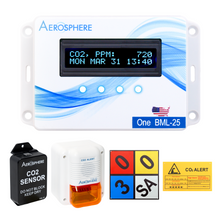
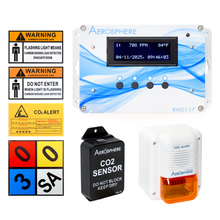
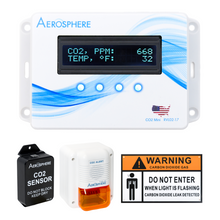
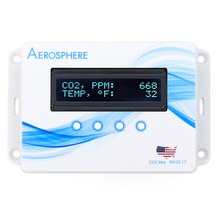
A properly installed CO2 monitoring system provides early warning and helps identify which sensor or area is detecting elevated CO2. This can help staff respond faster, ventilate the right area, and communicate more clearly with managers, technicians, gas suppliers, or emergency responders.
Train Staff Before an Alarm Happens
Every facility that uses CO2 should make sure employees understand what the alarms mean and what actions to take at each level. Staff should know where the CO2 tank or cylinder is located, where alarms and strobes are installed, how to recognize an alarm condition, who to notify, when to evacuate, and whether they are authorized to shut off the CO2 supply.
Procedures may vary depending on the local fire department, state or municipal code requirements, the authority having jurisdiction, equipment layout, and internal company policy. For that reason, each business should maintain a site-specific CO2 response plan and review it with employees regularly.
Training should also make clear that employees should not enter a high-alarm area to investigate unless they are trained and authorized to do so. In an emergency, evacuation and prevention of re-entry are more important than trying to find the leak.

CO2 Safety System Protocol Sign – Alarm Response Instructions