Indoor CO2 Monitoring for Schools, Offices & Shared Spaces

When discussing indoor air quality, temperature, humidity, and airborne pollutants often receive the most attention. However, another important factor can provide valuable insight into indoor ventilation: carbon dioxide (CO2).
For schools, offices, gyms, retail stores, and other shared indoor environments, monitoring CO2 levels provides a practical way to better understand ventilation conditions and identify when improvements may be necessary.
While commercial CO2 monitoring systems are often installed to address fire code requirements associated with bulk gas storage, indoor air quality monitoring serves a different purpose: helping people understand the air in the spaces they occupy every day.
What Does CO2 Tell Us About Indoor Air Quality?
Every person in a room produces carbon dioxide through normal breathing. When a space receives sufficient outdoor air, CO2 generated by its occupants is diluted through ventilation.
However, in crowded rooms or spaces with limited ventilation, carbon dioxide concentrations may gradually rise.
Because of this relationship, CO2 levels can serve as a useful indicator of ventilation performance in occupied indoor environments.
Consider a few everyday examples:
- Schools and Classrooms: CO2 concentrations may increase throughout the school day as students and teachers occupy the room.
- Offices and Workplaces: Conference rooms, shared offices, and break rooms can experience changing CO2 levels depending on occupancy and ventilation.
- Shared Indoor Spaces: Gyms, retail stores, libraries, and waiting rooms may experience fluctuations in CO2 levels as visitors come and go.
- Homes: Bedrooms, basements, and living spaces can accumulate CO2 when ventilation is limited, particularly overnight.
Monitoring these changes provides information that may help building managers, educators, business owners, and occupants recognize when ventilation deserves closer attention.
It is important to understand that CO2 is only one part of indoor air quality. A CO2 monitor does not directly detect particulate matter, airborne viruses, volatile organic compounds, or other pollutants. Instead, it provides a measurable indicator that can help evaluate how effectively indoor air is being exchanged with outdoor air.
Understanding Indoor CO2 Levels
Carbon dioxide concentrations are typically measured in parts per million (ppm), representing the number of CO2 molecules per million molecules of air.
Outdoor CO2 levels are generally in the hundreds of ppm, but concentrations vary depending on location, environmental conditions, and nearby sources of emissions.
Indoors, CO2 concentrations are influenced by several factors, including the number of occupants, room size, ventilation rates, and the duration of occupancy.
The following ranges provide general context for understanding indoor CO2 measurements:
| CO2 Concentration | General Interpretation |
|---|---|
| 400–600 ppm | Often associated with outdoor air or well-ventilated indoor environments |
| 600–1,000 ppm | Commonly observed in occupied indoor spaces |
| 1,000–1,500 ppm | May suggest that ventilation conditions should be evaluated |
| Above 1,500 ppm | May indicate substantial CO2 accumulation and warrant further ventilation assessment |
These ranges are general illustrations, not universal safety limits or regulatory thresholds. CO2 concentrations must be interpreted in the context of occupancy, outdoor CO2 levels, and the building's ventilation requirements.
One of the greatest advantages of using a CO2 air quality monitor is the ability to observe changes over time.
A single reading provides a snapshot, but continuous monitoring helps reveal patterns throughout the day, such as rising CO2 concentrations during meetings, classroom sessions, exercise classes, or other periods of high occupancy.

Why CO2 Monitoring Matters in Schools and Classrooms
Schools are among the environments where indoor CO2 monitoring can be particularly useful.
Classrooms often accommodate many students and teachers for extended periods. As occupants continuously release carbon dioxide, concentrations may increase if ventilation is insufficient.
Installing a CO2 monitor in a classroom can help educators and facility managers:
- Monitor carbon dioxide concentrations during normal classroom activities.
- Recognize rooms where ventilation may need further evaluation.
- Observe how occupancy affects indoor CO2 levels.
- Compare ventilation conditions throughout the school day.
- Evaluate changes after adjustments to ventilation practices.
Rather than relying solely on assumptions about ventilation performance, schools can use actual CO2 measurements to support informed facility-management decisions.
Classroom CO2 Monitoring Regulations in California and Nevada
The importance of classroom ventilation has also received attention from state lawmakers, including legislation in California and Nevada addressing indoor air quality in schools.
California Assembly Bill 841 (AB 841)
California's Assembly Bill 841 (2020) established the School Energy Efficiency Stimulus Program, which includes the School Reopening Ventilation and Energy Efficiency Verification and Repair Program.
The legislation addresses classroom ventilation assessments, repairs, and CO2 monitoring as part of efforts to improve ventilation in educational facilities.
Nevada Assembly Bill 257 (AB 257)
Nevada's AB 257 is another legislative reference relevant to discussions about indoor air quality in schools. Schools and facility managers should review the applicable provisions and implementation requirements to determine how the legislation relates to their facilities.
The Nevada Legislature provides access to legislative records and bill information.
CO2 monitoring does not replace the need for properly designed and maintained HVAC systems. However, it provides an additional source of information that can help schools recognize potential ventilation concerns.
CO2 Monitoring in Offices and Workplaces
Office buildings and workplaces face many of the same challenges as classrooms, particularly in areas where occupancy changes throughout the day.
Consider a conference room that remains empty for several hours before hosting a meeting. During the meeting, occupants continuously release CO2, potentially causing concentrations to rise if the room does not receive adequate outdoor air.
Without monitoring equipment, these changes may go unnoticed.
An office CO2 monitor can help facility managers better understand how different spaces perform under normal operating conditions.
Common applications include:
- Conference and meeting rooms
- Shared offices and collaborative workspaces
- Employee break rooms
- Training rooms
- Reception and waiting areas
By observing CO2 concentrations, facility managers can identify patterns, investigate potential ventilation issues, and evaluate the effects of changes to building operations.
For businesses interested in better understanding their indoor environments, CO2 monitoring offers a straightforward starting point.
CO2 Monitoring in Gyms, Retail Stores, and Shared Indoor Spaces
Not every indoor environment follows a predictable occupancy schedule. Gyms, retail stores, libraries, and other public-facing facilities often experience significant changes in the number of people occupying a space throughout the day.
These fluctuations can affect indoor CO2 concentrations, particularly when ventilation does not keep pace with changing occupancy.
Gyms and Fitness Centers
Fitness facilities can experience periods of high occupancy during group classes, peak workout hours, and other scheduled activities.
Because occupants are physically active, the amount of CO2 generated can also increase. Monitoring CO2 concentrations can help facility managers better understand ventilation conditions during these busy periods.
Retail Stores and Shopping Areas
Retail environments often experience changing customer traffic throughout the day.
CO2 monitoring can help store operators observe how occupancy relates to indoor ventilation conditions, particularly in enclosed shopping areas, fitting rooms, and other occupied spaces.
Libraries, Waiting Rooms, and Community Facilities
Libraries, medical waiting rooms, community centers, and similar facilities may accommodate groups of people for extended periods.
In these environments, CO2 monitoring provides additional information that can help facility managers evaluate ventilation performance during different operating conditions.
Although each facility has unique ventilation requirements, the underlying benefit remains the same: monitoring indoor CO2 levels helps identify changing conditions that may otherwise go unnoticed.
Can CO2 Monitoring Be Useful at Home?
While indoor CO2 monitoring is particularly valuable in schools and commercial environments, it can also provide useful information in residential spaces.
Bedrooms, home offices, and living areas can experience rising CO2 concentrations when occupied for extended periods, especially when ventilation is limited.
For example, a bedroom with closed windows and doors may accumulate CO2 overnight as occupants continue breathing.
A home CO2 monitor can help residents observe these changes and better understand how ventilation affects their indoor environment.
Indoor Air Quality Monitoring vs. Commercial CO2 Safety Monitoring
Although both applications involve measuring carbon dioxide, indoor air quality monitoring and commercial CO2 safety monitoring serve different purposes.
Indoor air quality monitors are primarily intended to measure CO2 concentrations in occupied spaces. They help users understand ventilation conditions and observe how carbon dioxide levels change throughout the day.
Commercial CO2 safety monitoring systems are designed for environments where carbon dioxide may accumulate to hazardous concentrations because of gas storage, equipment leaks, or other CO2-related operations.
Examples include restaurants using bulk beverage CO2 systems, breweries, convenience stores, and other facilities where compressed or liquefied carbon dioxide is stored or distributed.
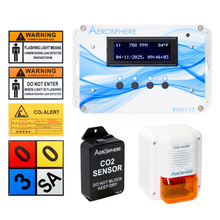
Depending on the installation and local fire code requirements, commercial safety monitoring systems may require additional equipment, including audible alarms, visual alarms, ventilation controls, and automatic gas shut-off devices.
A CO2 monitor designed for indoor air quality should not be used as a substitute for a required commercial CO2 safety system.
Understanding the distinction is important when selecting appropriate monitoring equipment for a particular environment.

Introducing the Aerosphere AQM Indoor Air Quality Monitor
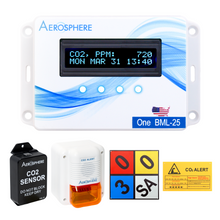
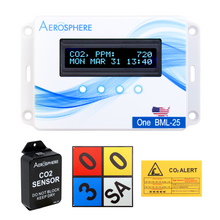
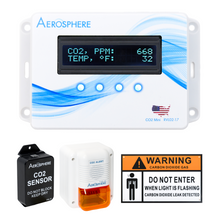
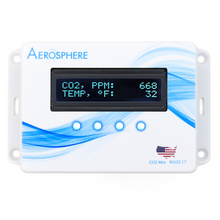
For schools, offices, shared indoor spaces, and homes, Aerosphere® offers its Air Quality Monitoring System (AQM), designed to provide convenient monitoring of indoor carbon dioxide concentrations.
The AQM helps users observe CO2 levels in real time and recognize changes that may warrant additional attention to ventilation.
Key Features of the Aerosphere AQM
- Real-Time CO2 Monitoring: Continuously displays carbon dioxide concentrations in parts per million (ppm).
- Easy-to-Read LCD Display: Features a white-on-black display with a horizontal CO2 level indicator.
- Audible and Visual Alerts: Provides notifications when configured CO2 thresholds are reached.
- Daily and Weekly Monitoring Information: Includes daily high readings and weekly threshold reports to help users review CO2 conditions over time.
- Simple Plug-In Operation: Uses a 110V power connection for straightforward setup.
Whether monitoring a classroom throughout the school day, observing CO2 levels in a busy office, or evaluating conditions in a gym or retail environment, the Aerosphere AQM provides a simple way to stay informed about indoor carbon dioxide concentrations.
Explore the Aerosphere AQM Indoor Air Quality Monitoring System to learn more about its features and applications.
The Aerosphere AQM is intended for indoor air quality monitoring and is not designed to replace commercial CO2 gas detection equipment required for fire code compliance.
Is Indoor CO2 Monitoring Required?
Not every building is required to install a CO2 monitoring system.
Requirements vary depending on the building's location, occupancy, ventilation design, equipment, and applicable regulations.
In many schools, offices, gyms, retail stores, and homes, CO2 monitoring is primarily used to support ventilation awareness rather than satisfy a specific gas detection requirement.
Some building and ventilation programs may incorporate CO2 monitoring into their requirements or performance evaluations. However, these provisions should not be confused with the fire code requirements that apply to certain commercial CO2 storage and dispensing installations.
For facilities using bulk CO2 systems, including beverage dispensing operations, dedicated commercial gas detection equipment may be required under applicable fire codes.
Even when indoor air quality monitoring is not mandatory, measuring CO2 can provide useful information about changing ventilation conditions.
Better Indoor Air Quality Starts With Better Information
Understanding indoor CO2 concentrations is one way to make more informed decisions about ventilation.
From classrooms and conference rooms to gyms, retail stores, and other shared indoor environments, monitoring carbon dioxide provides visibility into conditions that might otherwise go unnoticed.
At Aerosphere®, our expertise is focused on carbon dioxide monitoring. We offer solutions for both indoor air quality awareness and commercial CO2 safety applications, helping customers select equipment suited to their environment.
Looking to monitor indoor CO2 levels?
Explore the Aerosphere AQM Indoor Air Quality Monitoring System for real-time CO2 monitoring in schools, offices, shared indoor spaces, and homes.
Need CO2 monitoring for bulk gas storage, beverage dispensing, or fire code compliance?
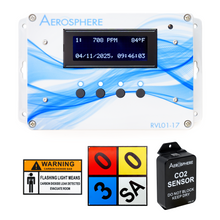
Learn more about our Aerosphere Primary CO2 Monitoring System, designed for commercial CO2 safety applications.