The Modern Business Guide to NDIR CO2 Monitoring
Discover how non-dispersive infrared (NDIR) CO2 sensors work, their applications, and how they contribute to better air quality monitoring in various environments.

What NDIR CO2 Sensors Do and Why They Matter
Most CO2 sensors today work by measuring how much infrared light is absorbed by CO2 molecules in a sample of air. The more CO2 present, the more light is absorbed. By measuring that change, the sensor can calculate an accurate CO2 concentration.
This measurement method is called non dispersive infrared, or NDIR. It is the most common and trusted technology used for CO2 monitoring in commercial and industrial environments because it is accurate, stable, and reliable over long periods of time.
Unlike older sensor types that rely on chemical reactions, NDIR sensors use light and physics. Nothing is consumed or worn out during measurement. That makes NDIR the preferred choice for businesses that need continuous monitoring without frequent replacement or calibration issues.

What Is an NDIR Sensor?
NDIR stands for Non-Dispersive Infrared, a technology that measures gas concentrations by analyzing how infrared light is absorbed by specific molecules in the air. In the case of CO2 monitoring, these sensors detect the unique infrared signature of carbon dioxide.
As explained Sentra Controls, CO2 molecules absorb infrared radiation at a wavelength of approximately 4.2 microns. This absorption feature allows NDIR sensors to selectively detect CO2 concentrations in the air, making them highly accurate and stable over time.
How NDIR CO2 Sensors Work in Simple Terms
An NDIR CO2 sensor contains a small infrared light source and a chamber that allows air to pass through. Carbon dioxide absorbs a very specific wavelength of infrared light. Other gases do not.
As air moves through the sensor, the infrared light shines across the chamber. Some of that light is absorbed by CO2 molecules. A detector at the other end measures how much light makes it through. The difference between the emitted light and the detected light directly corresponds to the amount of CO2 in the air.
Because this absorption pattern is unique to CO2, NDIR sensors can measure gas concentration accurately without interference from oxygen, nitrogen, or humidity.
According to sensor manufacturers and safety agencies, this is why NDIR technology has become the standard for indoor air quality, industrial safety, and regulated CO2 environments.
Why CO2 Monitoring Is a Business Priority
Carbon dioxide is colorless and odorless. People cannot sense elevated levels until symptoms begin to appear. According to OSHA and NIOSH, increased CO2 exposure can cause headaches, dizziness, fatigue, and impaired decision making, even at levels well below what most people consider dangerous.
In businesses that use or store CO2, leaks can occur silently. Beverage systems, bulk tanks, fermentation processes, and grow environments all introduce potential exposure risks. Without monitoring, staff may be exposed before anyone realizes there is a problem.
Beyond safety, CO2 levels also affect comfort and performance. Studies referenced by Harvard’s School of Public Health show that elevated indoor CO2 levels reduce cognitive function and decision making. For businesses, that translates to slower service, distracted staff, and uncomfortable customers.
There is also a regulatory component. Many fire codes, including IFC and NFPA standards, require CO2 monitoring when facilities store regulated quantities of carbon dioxide. Employers are also responsible under OSHA rules for maintaining safe air conditions for workers.
Where NDIR CO2 Sensors Are Used
NDIR CO2 sensors are used across industries because they provide continuous, reliable monitoring in real world environments.
In restaurants, bars, and quick service locations, NDIR sensors monitor beverage systems, storage rooms, and walk in coolers. Early detection helps prevent staff exposure and operational issues like system failures or product loss.
Breweries rely heavily on NDIR sensors because fermentation produces large volumes of CO2. Gas can accumulate near the floor in cellars and tank rooms. Properly placed sensors provide critical alerts before levels become dangerous.
Hotels, stadiums, and large venues often use NDIR sensors as part of demand controlled ventilation systems. According to the National Institute of Standards & Technology, adjusting ventilation based on CO2 levels improves air quality while reducing energy costs during low occupancy periods.
Convenience stores and retail locations often store CO2 tanks in small, poorly ventilated back of house spaces. Continuous monitoring helps protect employees in areas that are frequently overlooked.
According to the Smithsonian Magazine, grow houses and indoor agriculture facilities intentionally add CO2 to increase plant growth. NDIR sensors allow operators to maintain optimal concentrations for crops while keeping worker exposure within safe limits.
Why NDIR Sensors Are Preferred Over Other Technologies
There are many types of gas sensors on the market, but NDIR remains the go-to for CO2 detection due to the following advantages:
1. High Accuracy
NDIR sensors are known for delivering consistent, repeatable CO2 measurements across a wide range of conditions. This level of stability makes them well suited for environments such as labs, greenhouses, and smart HVAC systems, where dependable readings are critical for system performance and operational decision-making.
2. Long-Term Stability
Thanks to their solid-state architecture and lack of reactive materials, NDIR sensors can operate for over five years without drift. This reliability reduces maintenance needs and eliminates the risk of faulty readings, as highlighted ADD
3. Resistance to Environmental Conditions
Electrochemical sensors can be thrown off by humidity and temperature swings, but NDIR sensors remain stable across a wide range of conditions. This makes them ideal for deployment in variable environments like greenhouses and factories. found that NDIR sensors are less prone to environmental interference, which ensures consistent performance even in harsh or fluctuating climates.
4. Maintenance-Free Operation
Because they don't rely on chemical reactions, NDIR sensors require no consumables and little to no recalibration. This allows facilities managers and integrators to deploy them and essentially "set and forget" for years.
5. Digital Integration
Most modern NDIR CO2 sensors support digital interfaces such as UART, Modbus, and I2C, which simplifies integration into existing building management or automation systems. As explained by this plug-and-play capability, NDIR is a scalable choice for everything from smart thermostats to large-scale industrial control systems.
Not all CO2 sensors perform the same way. Low cost chemical sensors degrade over time and are sensitive to humidity and temperature changes. Many require frequent replacement and recalibration, increasing long term cost and downtime.
NDIR sensors, by contrast, routinely last ten years or more. Because they do not rely on consumable materials, their readings remain stable and predictable. This makes them ideal for environments that operate continuously or are subject to inspections.
Humidity resistance is another major advantage. Kitchens, breweries, and grow houses are naturally damp environments. NDIR sensors are designed to operate accurately under these conditions without performance loss.
For compliance and risk management, installing a high quality NDIR monitoring system demonstrates proactive safety planning. This can support smoother inspections, fewer citations, and stronger insurance positioning.
Frequently Asked Questions
What does NDIR mean?
NDIR stands for Non-Dispersive Infrared, a method for measuring gases like CO2 by analyzing infrared light absorption. It is known for its accuracy and long-term reliability.
How do NDIR CO2 sensors work?
They detect the amount of infrared light absorbed by CO2 molecules. The sensor uses this data to determine the CO2 concentration in the air, making it a stable, non-chemical method of gas detection.
Is an NDIR sensor better than electrochemical alternatives?
Yes, especially for long-term, accurate measurements. NDIR sensors last longer, require less maintenance, and are not affected by humidity or temperature changes like electrochemical sensors.
Can I integrate an NDIR sensor into my own product?
Absolutely. Many sensors on the market today are OEM-ready, featuring standard communication protocols and small footprints for integration into HVAC controls, environmental monitors, or smart devices.

Why Aerosphere NDIR Sensors Are Built for Real World Use
While NDIR is the standard technology, not all NDIR sensors are built the same.
Aerosphere uses dual beam NDIR technology, which continuously verifies sensor accuracy by comparing measurement data against a reference signal. This design minimizes drift and ensures long term reliability without constant recalibration.
Aerosphere systems are designed specifically for commercial CO2 environments. Loud kitchens, humid breweries, and continuously operating grow facilities demand equipment that performs reliably outside of laboratory conditions.
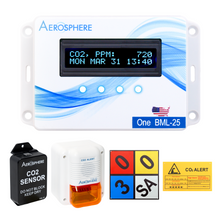
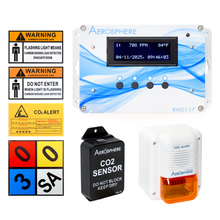
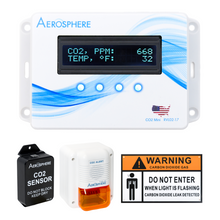
Our systems provide clear visual and audible alarms that align with IFC and NFPA requirements. Instead of simply displaying numbers, Aerosphere monitors are designed to prompt immediate, compliant response when thresholds are exceeded.
Everything is built around uptime, clarity, and code compliance.
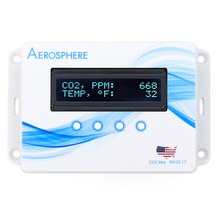
For more details on our Aerosphere line of CO2 gas monitoring solutions and accessories, visit our shop page to get one today!